My topic is:How do contrasts in character design and storytelling create humour in 3D animation? This is because I tend to remember stories built on contrasting setups very clearly, yet this kind of effect often depends on certain design choices and planted foreshadowing, so I would like to research this area in depth.
Literature sources I have identified include:
This paper explains why transgressive elements elicit humour rather than fear — which directly addresses why contrast‑based settings work.
McGraw, A. P. & Warren, C. (2010) Benign Violations: Making Immoral Behavior Funny, Psychological Science 21(8), 1141–1149
This paper analyses why the slapstick disjuncture of robots performing human actions in Pixar’s WALL‑E is funny, situating it within the historical context of labour and technology.
Flaig, P. (2016) — Slapstick After Fordism: WALL-E
Taking The Simpsons as a case study, this paper argues that animated humour possesses a “reflexive function of memory”: animation not only generates memories but also invites reflection on how memory is constructed.
Hellmann, O. (2023) — Animated satire and collective memory
11/24
During my tutorial, my tutor pointed out that my original topic was too broad. Based on their feedback, I narrowed it down to the following research question:
How does the contrast between upbeat music and bleak situations create dark humour in 3D animation?
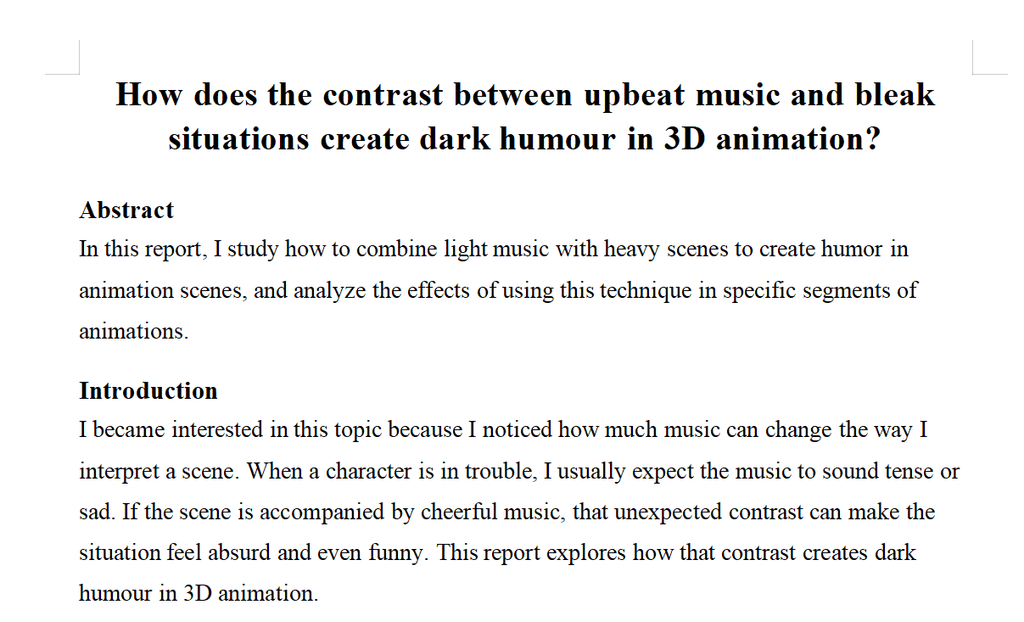
To explain how the contrast between sound and visuals affects the audience’s emotions and expectations, and why this contrast might make the audience feel ironic, I searched for literature on some academic websites and found the following related papers.
Rosenfeld & Steffens (2019) — Effects of Audiovisual Congruency on Perceived Emotions in Film
1. Choosing My Topic
At first, I wanted to study how contrast creates humour in 3D animation. I looked at character design, settings and storytelling. I then decided to focus on music. My research question is how does upbeat music create dark humour when it plays over a bleak scene?
2. Finding Sources
I searched JSTOR and EBSCOhost for terms like film music and audiovisual incongruity. Rosenfeld and Steffens (2019) found that cheerful music could make negative images feel sarcastic. Ireland (2015) helped me understand how music and images can suggest different emotions. These ideas helped me decide what to look for in my chosen clip.
3. Analysing a Scene
I chose a scene from Madagascar (2005) where Alex leaves his friends. He is afraid he might hurt them, but the song ‘What a Wonderful World’ sounds warm and hopeful. I focused on when the song starts. For me, the contrast makes his departure feel both sad and slightly absurd.
4. Applying It to My Own Work
I have written a first draft of my report. My next step is to compare the same clip with and without music. In my own animation, I would like to try bringing in the music at two different points, first when the problem appears and then after the character reacts. I want to see which version makes the moment feel both funny and uncomfortable.
Leave a Reply